
|
| Catch NSFW and Inappropriate Content Instantly with Cloudmersive MultiThreat Detection |
| 6/16/2026 - Brian O'Neill |
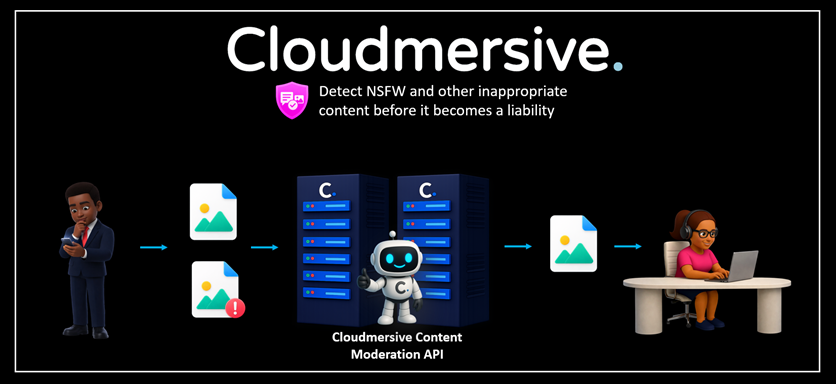
Every file upload is a liability questionWhen planning enterprise content security, it’s easy to get fixated on the threat of external attackers. File upload endpoints see a high volume of malware and a growing share of AI-generated fraud, and email inboxes see an exceptionally large amount of spam, including phishing attacks targeting employee credentials. It’s easy to forget there’s a category of risk that originates closer to home: the liability of hosting uploaded content on a shared platform. Every day, employees upload images to internal collaboration tools, and external users submit documents through customer-facing portals. All sorts of files get attached to support tickets when problems arise, and those are shipped through enterprise support management systems. In all these cases, the enterprise is the host, and the enterprise bears responsibility for what each piece of content contains. When inappropriate or harmful content passes through your platform undetected, it creates legal exposure, compliance violations, and reputational damage that no antivirus, antifraud, or antiphishing security perimeter was designed to prevent. This is a content moderation problem, and it requires an automated detection solution every bit as rigorous as the other major threat categories. Why content moderation is harder to manage than it soundsFor many organizations, the instinct is to rely on community reporting or human moderation (i.e., risk management teams and regular employees) to catch inappropriate content. That might be workable at super low volumes, but not at enterprise scale. Mid-to-large sized enterprises see thousands of uploads per day across multiple platforms and workflows, and at that volume, inappropriate content tends to circulate and cause damage long before a human reviewer sees it. The compliance dimension compounds this problem. Depending on industry and jurisdiction, certain categories of inappropriate content (e.g., CSAM, content depicting illegal activity, content creating hostile workplace conditions, etc.) carry mandatory reporting obligations and significant legal liability. Saying “we didn’t know it was there” is not a viable defense when automated detection tools exist. How the Cloudmersive Content Moderation API addresses this problemThe Cloudmersive Content Moderation API (also referred to as the NSFW API) classifies images, documents, and video for inappropriate and harmful content using advanced AI, and it returns results fast enough to act on before content enters exposed storage or workflows. How it worksThe standard classification endpoint scores images on a clean-to-unsafe spectrum, returning a
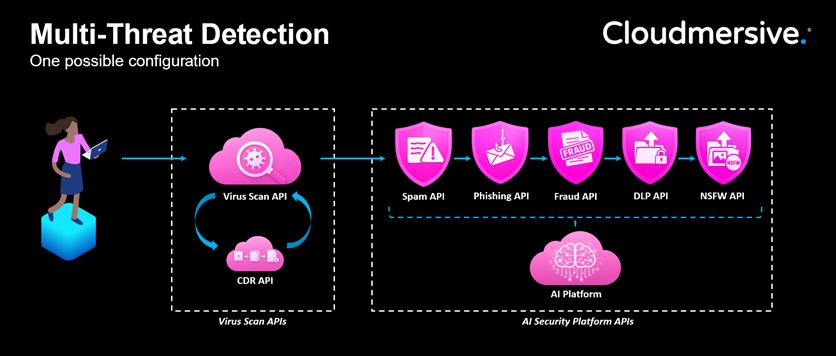
This level of specificity is designed to accommodate organizations with different tolerance thresholds for different content types. For example, a medical platform clearly has different requirements around medical imagery than a general enterprise collaboration tool; what constitutes “inappropriate” in one vertical might not necessarily apply to another. Beyond images, the Content Moderation API classifies across PDF, Word, Excel, and PowerPoint formats, and it extends to video, too, scanning across each frame in MP4, MOV, WEBM, MKV, AVI, FLV, MPG, and GIF formats. For organizations handling user-generated video content at scale, this covers an area that image-only moderation tools leave wide open. Note that video classification does require a Managed Instance or Private Cloud deployment with GPU support.Where the Content Moderation API fits in your workflowsSimply put: content moderation belongs at every surface where users can submit media to a shared platform. While upload endpoints are the most crucial point, allowing you to catch inappropriate content before content enters storage, document processing pipelines represent another natural fit, particularly for platforms where external users submit files that other external users will later access or download (this can be a significant area of risk). For organizations running Cloudmersive Multi-Threat Detection, content moderation is the final layer in the stack. It’s the layer that closes the internal threat vector after virus scanning, fraud detection, data loss prevention (DLP), and spam/phishing detection have handled everything else arriving from the outside. A file that passes every other check may still contain content that creates liability when it reaches your platform, and the Content Moderation API is what catches it. Deployment optionsLike all Cloudmersive APIs, the Content Moderation API is available across the full range of deployment options described below. Note again that the advanced image classification endpoint and video classification require a Managed Instance or Private Cloud deployment with GPU support. Enterprises can integrate the Content Moderation API wherever it fits best in their existing architecture, and under whatever regulatory or data governance constraints apply to their environment. Managed InstanceDedicated managed infrastructure with SLAs, customizable deployment, and enterprise security controls. Required for advanced image classification and video classification. Private CloudDeploy on your own premises or within a cloud platform of your choice. Also supports advanced image and video classification with GPU. Public CloudLeverage Cloudmersive's multi-tenant public cloud offering for standard image and document classification. PaaSDeploy via Azure App Service or Azure Kubernetes Service. Government CloudDeployment in a specified government cloud region, meeting the data governance requirements of government entities. Get started todayContent moderation is the final pillar of Cloudmersive Multi-Threat Detection, addressing the threat that doesn’t necessarily come from outside your organization at all. Together, all five Multi-Threat pillars cover every threat vector enterprises can expect to face: what’s coming in, what’s going out, and what internal users are uploading to sensitive platforms. To learn more about the Content Moderation API, visit our documentation or API console for technical details and code examples. For expert advice or to book a Multi-Threat Detection demo with your own data examples, reach out to a member of our team. |
Sign Up Now or 

 Blog
Blog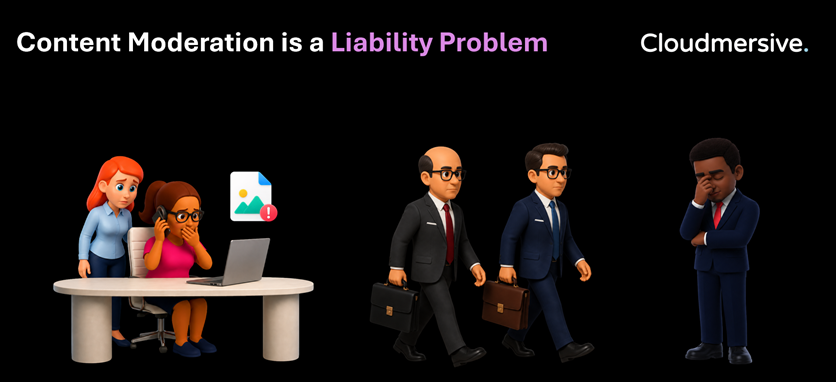
 Virus Scan APIs
 Content Disarm and Reconstruction APIs
 Spam Detection APIs
 Document Conversion & Processing APIs
 Document AI APIs
 Natural Language Processing (NLP) APIs
 Optical Character Recognition (OCR) APIs
 Image and Face Recognition and Processing APIs